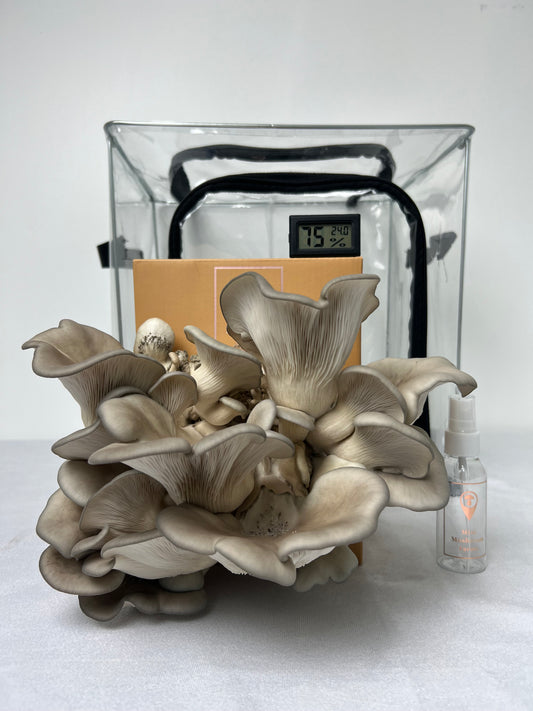
Lion's Mane Mushroom
Lion's mane (Hericium erinaceus) looks nothing like other mushrooms: a white, shaggy ball of soft hanging spines. It's mild, slightly sweet and meaty, and it's a favourite for vegetarian "crab cakes", sandwiches and stir-fries. Here's what it tastes like, how to cook and store it, and how to grow your own.
Quick facts
- Species: Hericium erinaceus
- Look: a white, rounded cluster of hanging spines, with no caps or gills
- Taste: mild and slightly sweet, often compared to crab or lobster
- Texture: meaty and stringy when torn, tender when cooked
- Time to grow at home: starts in 2–3 weeks from a ready-to-fruit kit
What does lion's mane taste like?
Lion's mane has a mild, slightly sweet flavour and a texture that many people compare to crab or lobster. It soaks up whatever you cook it with, so it works well with butter and garlic, barbecue sauce, smoky spices or soy sauce. Torn into strips and cooked, it shreds like pulled meat, which is why it's popular in vegetarian sandwiches.
How to cook lion's mane
- Tear or slice. Tear it into bite-size pieces, or cut it into thick slices to cook like a steak.
- Cook off the water first. Lion's mane holds a lot of water. Start it in a hot, dry pan until the water cooks off, then add butter or oil and let it brown.
- Press it. Pressing the pieces flat in the pan with a spatula gives a meaty texture and a golden crust.
- Always cook it. Like most mushrooms, lion's mane should be eaten cooked.
Try it in our BBQ Pulled Lion's Mane Sandwich, the Montreal Smoked Lion's Mane Sandwich, Lion's Mane Caramel Corn or Dehydrated Mushroom Ramen, or browse all our mushroom recipes.
How to store fresh lion's mane
Keep it in a paper bag or a container lined with paper towel in the fridge, not in sealed plastic. It's best within a few days, while it's still white. To keep it longer, dry it and store it in a jar.
How to grow lion's mane at home
Lion's mane is slower than oyster mushrooms, but just as easy. With a ready-to-fruit kit:
- Cut an X in the front of the bag with a clean knife.
- Keep it at 18–28 °C, in indirect light, inside a humidity tent (above 70% humidity).
- Mist the tent 2–3 times a day.
- Mushrooms start in 2–3 weeks. Harvest while the spines are still white, before they turn yellow.
You can keep a kit in the fridge before you start it. Our 4.3 lb lion's mane kit gives ½ to 1 lb per harvest, with the next harvest usually ready 2–3 weeks later, and the first harvest is guaranteed. See the Lion's Mane Grow Kit Gift Set, or read our full guide to growing mushrooms at home.
Lion's mane vs oyster mushrooms
- Look: lion's mane grows as one round, shaggy clump of spines; blue and pink oysters grow as clusters of fan-shaped caps.
- Taste and texture: lion's mane is sweeter and more seafood-like; oysters are more savoury and earthy.
- Growing time: lion's mane takes 2–3 weeks to start; oyster kits start in 7–10 days.
Common questions
Is lion's mane safe to eat?
Yes, cultivated lion's mane is a culinary mushroom. Cook it before eating, and don't eat wild mushrooms unless an expert has identified them.
Is lion's mane psychedelic?
No. Lion's mane is a culinary mushroom with no psychoactive effects.
Why is lion's mane slower than oyster kits?
It's simply a slower-growing species. Expect the first growth in 2–3 weeks rather than 7–10 days. Keep misting and keep the tent humid while you wait.
How do I know when lion's mane is ready to harvest?
When the clump is full and the spines are about 0.5–1 cm long but still white. If the tips start turning yellow or brown, harvest right away.
-

 Sale
2 Grow Kits Bundle
Regular price $64.00 CADRegular priceUnit price per$69.00 CADSale price $64.00 CADSale -
Grow Tent Gift Set +2 Grow Kits
Regular price $89.00 CADRegular priceUnit price per$125.00 CADSale price $89.00 CADSale -
2 Grow Tent Gift Sets +2 Grow Kits
Regular price $109.00 CADRegular priceUnit price per$180.00 CADSale price $109.00 CADSale -
4 Grow Kits Variety Pack
Regular price $99.00 CADRegular priceUnit price per$138.00 CADSale price $99.00 CADSale -
Grow Tent Gift Set + Grow Kit
Regular price $69.00 CADRegular priceUnit price per$90.00 CADSale price $69.00 CADSale